Most companies will adopt AI long before they replace the software that runs their business. We built Eko to connect those two worlds.
Most conversations about AI start with a clean sheet. Choose the latest software, connect the right data and let an agent handle the work.
Businesses rarely have a clean sheet.
They have payroll platforms that pay people correctly every month, supplier portals they are required to use and internal systems that have accumulated years of data. A founder may dislike one of these tools and still decide that replacing it is a bad use of time and money. The software may be dated, but the work inside it still has to get done.
I think the AI industry is too quick to assume that all of this software will disappear. It will change, and some of it should be replaced, but technology transitions usually take much longer than the first wave of excitement suggests.
Networked email dates to 1971. More than fifty years later, the U.S. Postal Service still handled about 42 billion pieces of First-Class Mail and nearly 57 billion pieces of Marketing Mail in its 2025 financial year. Email changed communication, but physical mail retained jobs that people and businesses still needed it to do.
Cars show the same pattern. Electric vehicles are more efficient and usually cheaper to run. Sales have grown quickly, yet EVs accounted for only one in four new cars sold worldwide in 2025. Adoption depends on purchase price, charging access, local policy and what buyers are comfortable using. A better technology can grow quickly without replacing its predecessor at the same speed.
Business software will follow its own version of this pattern. AI-native tools will spread, while older applications continue running beside them. That overlap is where Eko fits.
Old software is often a business decision#
The word "legacy" can make an existing system sound like a mistake waiting to be corrected. Sometimes it is. Unsupported software can introduce serious security and reliability problems. In many companies, though, the system remains because replacing it would be expensive and disruptive.
Moving away from an established platform may require a data migration, new controls, staff training and months of testing. Regulated companies can face an additional review or audit. Even a small startup has to weigh that work against product development, sales and keeping the business running.
We use "legacy" broadly. It might describe a specialist desktop program used by one department, a customer website with no useful API or a process that moves through PDFs and spreadsheets. A current SaaS product can create the same problem when one important action is missing from its integration.
Government systems provide an unusually visible example. In 2025, the U.S. Government Accountability Office reviewed critical federal systems between 23 and 60 years old. They supported work including tax processing and healthcare. Federal agencies typically report spending about 80% of their IT and cyber budgets on operating and maintaining existing systems. Of ten critical systems identified for modernisation in 2019, only three had completed that work by February 2025.
Government is an extreme case, but the underlying calculation is common. The more important a system is, the harder it can be to replace safely.
AI use is growing faster than agentic work#
Stanford's 2026 AI Index found that 88% of surveyed organisations used AI in 2025. Seventy percent used generative AI in at least one business function. Agent deployment remained in the single digits across almost every function measured.
That difference matches what happens in daily work. Someone can use ChatGPT to research a customer, review a document or decide what to do next. They then copy the result into an accounting system, open a separate portal and finish the process manually.
The model has produced an answer. The job is still unfinished.
Many AI products are being built to improve the thinking part. We are interested in what happens after that. How does a useful answer become an action inside the software a company already uses? What happens when that software has no API, or when its API cannot perform the required step?
Integration-based automation works well when the necessary connectors and actions exist. It becomes more difficult when a workflow crosses a desktop application, a document and a closed web portal. Custom development is possible, but it adds cost and future maintenance. Small teams often keep the manual step because fixing it is hard to justify.
A person can handle these gaps by looking at the interface. They read the screen, work out the current state and take the next action. Eko applies the same operating model to automation.
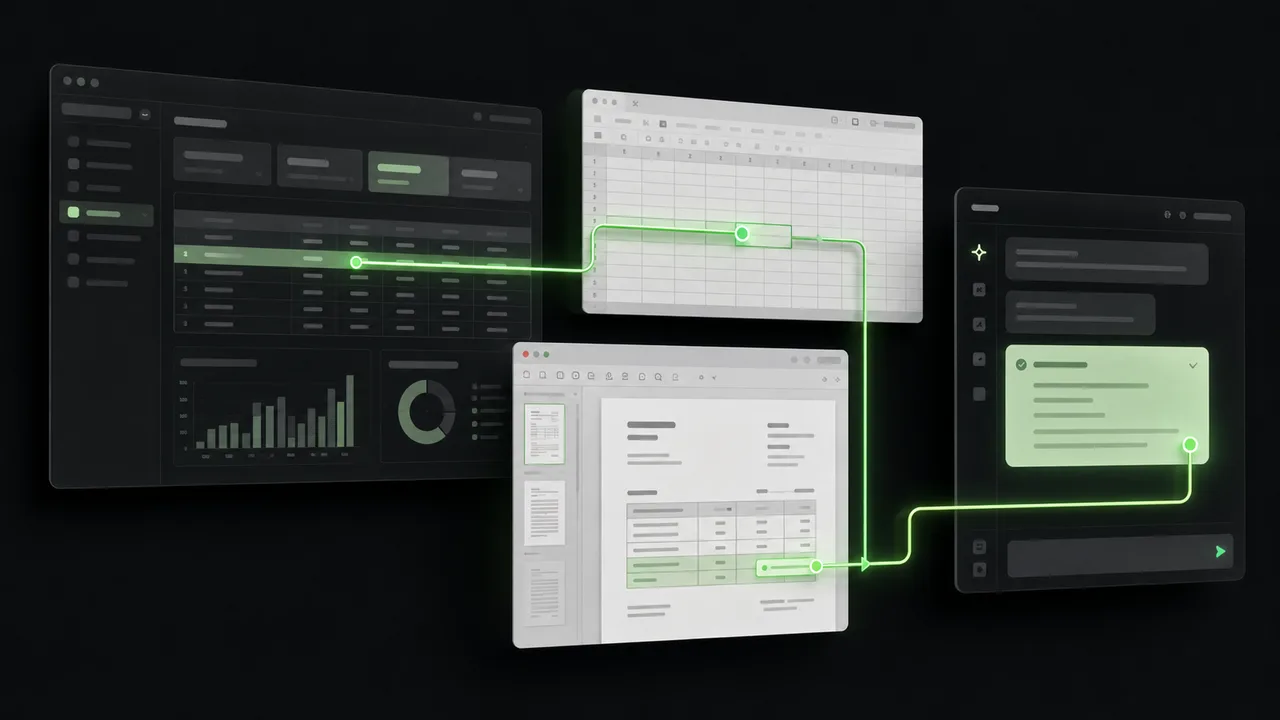
Eko uses computer vision and OCR to read what is visible. It can work through websites, Mac applications and documents by interacting with their interfaces. The user describes the task in normal language and reviews the proposed steps before the workflow runs. There is no need to build a separate integration for each application.
Our practical test is straightforward: if someone can carry out a repeatable process from the screen, we want Eko to be able to carry it out too.
Where Eko fits with other agents#
We expect companies to use several AI products. One may be good at research, another at financial analysis and another at a specific industry task. Trying to replace all of them with Eko would make little sense.
Eko's role is to help those systems reach the software where the work must be completed. An agent may decide which invoice needs attention. Eko can work through the accounting portal used by the company, collect the relevant information and carry out the approved next step. The value lies in connecting an AI decision to the actual operating environment.
Eko already connects to AI models through their APIs, bringing their capabilities directly into the Eko app. Users can generate content and use the results as part of an automated workflow without switching between applications. Over time, we will give users the flexibility to choose the right intelligence for each task while Eko manages execution across their existing software.
AI-ready without a full rebuild#
There are good reasons to modernise software. Eko should never become an excuse to retain an insecure or unreliable system. Companies will replace parts of their stack as the business case becomes clear.
What I question is the idea that a company must finish that transformation before it can benefit from AI. A startup should be able to automate work around its current setup and learn where AI provides value before committing to a large migration.
Consider a process that begins with an AI review and continues through an email client, a spreadsheet and a supplier portal. Eko can work with the interfaces the team already knows. The company gets an AI-assisted workflow while the original systems remain in place. It can modernise those systems later without postponing every improvement until then.
This approach also changes who can build an automation. The person who understands an operational process is often in finance, customer support or another business team. That person may know exactly which steps waste time without knowing how to write code or configure an API.
Eko starts with their description of the work. It reads the screen and proposes a sequence for review. The operational expert can inspect the process directly instead of translating it into a technical specification for someone else.
Working without integrations still requires controls. Eko needs the permissions required to operate on a Mac, and a workflow needs clear instructions. The product is designed to stop for credentials, payments and other sensitive actions. Users can see what it plans to do before approving the run.
This is necessary for trust, especially while companies are learning where automation is dependable and where a person still needs to decide.
Why this transition needs a bridge#
Some people describe compatibility with older software as a temporary feature. Once every company moves to AI-native applications, they argue, a bridge will no longer be necessary.
I do not expect that day to arrive. Companies add systems at different times, acquire businesses with different technology and retain specialist tools because those tools solve a narrow problem well. Even after today's software is replaced, there will be another generation of AI capabilities that existing applications were not designed to use.
We built Eko for the long period of overlap. Founders can start automating a working setup today and replace individual systems later, when the decision makes sense.
For me, the vision is practical. Let AI agents do the work they are good at. Let companies keep the software they still need. Eko connects the decision to the action on screen.
That is the problem we are building the company to solve.